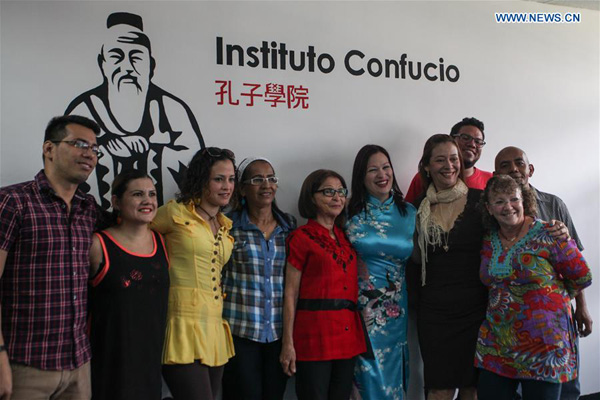
Confucius Institute
Introduction
The Confucius Institute is a global network of educational centers established to promote Chinese language and culture. Modeled after other cultural organizations like the British Council and France's Alliance Française, Confucius Institutes collaborate with local universities and educational institutions across the world. These institutes aim to foster a deeper understanding of Chinese language, history, and culture through language instruction and cultural exchanges. Since its establishment, the Confucius Institute has become a key player in facilitating people-to-people exchanges between China and other nations, offering a platform for academic collaboration, cultural activities, and mutual understanding.
Global Reach
Since its inception in 2004, the Confucius Institute has expanded its reach worldwide. By the end of 2023, a total of 496 Confucius Institutes and 757 Confucius Classrooms are established by Chinese and foreign partner institutions with the principle of “planning together, building together, and benefiting together”, which has been consistently catering to the needs of people worldwide to learn Chinese and understand Chinese culture. They have served 160 countries and regions globally, hence a leading brand in international Chinese education.
Programs and Services
Confucius Institutes offer a variety of educational and cultural programs tailored to local needs and interests. These programs are designed to enhance the understanding of Chinese language and culture among students and communities worldwide.
Language Education
At the core of the Confucius Institute's offerings is Chinese language education. The Institutes provide structured language courses for students of all ages, from primary school children to university students and adults. These programs range from beginner to advanced levels, focusing on listening, speaking, reading, and writing skills. Through partnerships with local universities, the Institutes offer degree programs in Chinese language and literature, teacher training, and certification exams such as the Hanyu Shuiping Kaoshi (HSK), the official test of Chinese proficiency.
The Chinese Bridge competition, a key initiative of the Confucius Institute's Chinese language education, serves as a vibrant platform to enhance global students' proficiency in Chinese and deepen their cultural awareness. Featuring language contests, cultural exchanges, and academic activities, the Chinese Bridge offers participants exclusive avenues to enrich their understanding of Chinese language and culture. With millions of participants hailing from over 160 countries, the Chinese Bridge has emerged as a pivotal hub for language acquisition and cultural interchange.
Cultural Activities
In addition to language education, the Confucius Institutes organize a wide array of cultural activities to engage the local communities and promote deeper understanding of Chinese culture. These activities include traditional Chinese arts such as calligraphy, ink painting, kung fu, tai chi, as well as celebrations of Chinese festivals like the Dragon Boat Festival and Mid-Autumn Festival. The Institutes also host cultural exchange events, workshops, and performances that showcase Chinese music, dance, and cuisine, providing students and community members with immersive cultural experiences.
Research and Collaboration
Confucius Institutes play a critical role in fostering academic exchange and research collaboration between China and other countries. They organize seminars, conferences, and workshops on diverse topics related to Chinese culture, economy, society, and more. These events serve as platforms for scholars, educators, and students to share knowledge, exchange ideas, and deepen mutual understanding. Notably, the Institutes facilitate joint research projects and academic partnerships with local universities, contributing to the global dialogue on various academic and cultural issues.
Regional Developments
Confucius Institutes have expanded globally with notable regional impacts. In Europe, the Confucius Institute in Barcelona has played a crucial role in facilitating cross-cultural understanding and education, drawing thousands of students. In Africa, the Confucius Institute at the University of Cape Coast in Ghana has become pivotal in enhancing cultural exchanges and language proficiency, driven by the increasing economic ties between China and African nations. In the Middle East, the Confucius Institute in Saudi Arabia's capital Riyadh fosters cultural exchange, aiming to train local Chinese language teachers. In the Americas, institutes like the one in Havana, Cuba, have significantly contributed to cultural and educational exchanges, creating opportunities for local students to study in China.








